A cabinet door can look beautiful in a showroom and still be the wrong fit for your home. That is where a solid wood cabinetry buying guide becomes useful – not as a sales pitch, but as a way to separate lasting value from expensive disappointment.
If you are planning a kitchen remodel in Nashville or the surrounding area, you are probably weighing a few competing goals at once. You want cabinetry that feels refined, holds up to daily life, and makes the investment feel worthwhile. At the same time, you do not want to overpay for features you do not need or get pulled into vague promises about quality. Solid wood cabinets can absolutely be worth it, but only when you know what you are actually buying.
What solid wood cabinetry really means
The phrase gets used loosely, and that is part of the confusion. Solid wood cabinetry typically means that the door frames, drawer fronts, and often exposed components are made from real hardwood rather than particleboard, MDF, or laminate-wrapped materials. That does not always mean every part of the cabinet box is solid wood.
In many well-built kitchens, a cabinet may have solid wood doors paired with a high-quality plywood box. That is not a downgrade. In fact, it is often a smart construction choice because plywood provides strength and dimensional stability while solid wood delivers the warmth and character homeowners want to see and touch.
What you want to watch for is language that sounds premium but hides shortcuts. “All wood” may simply mean there is no particleboard, while “solid wood” may apply only to the face frame. A good builder or remodeler should explain exactly which parts are hardwood, which are plywood, and why those choices were made.
A solid wood cabinetry buying guide starts with construction
Before you get attached to a stain color or door style, focus on how the cabinets are built. Construction affects how your cabinets perform far more than most finish details.
Solid wood doors and drawer fronts are usually the first priority because these are the moving parts and the most visible surfaces. For cabinet boxes, plywood is often preferred over solid wood because it resists warping better in a climate with humidity swings. In Middle Tennessee, that matters. Wood naturally expands and contracts with moisture in the air, so the best cabinet build is not always the one with the most hardwood in every square inch. It is the one designed to stay stable over time.
Joinery also matters. Dovetail drawers, reinforced corners, quality glides, and soft-close hinges all contribute to daily performance. If a cabinet looks high-end but the drawers feel light, loose, or rough in motion, the beauty will wear thin fast.
Choosing the right wood species
Not all solid wood cabinets behave the same way. Different species affect the look, durability, and final price.
Maple is one of the most popular choices because it is durable, smooth-grained, and versatile. It paints well and can also take stain, though it has a cleaner, more uniform look than more textured woods. If you want a timeless kitchen that leans bright, tailored, and polished, maple is often a strong fit.
Oak has more pronounced grain and a lot of character. White oak in particular has become a favorite for homeowners who want warmth without an overly rustic look. It can feel upscale, natural, and current at the same time. Red oak is usually more budget-friendly, though its grain pattern is more traditional.
Cherry brings richness and depth. It darkens over time, which many homeowners love, but that aging process should be part of the decision. If you want a wood that develops a lived-in patina, cherry can be beautiful. If you prefer a color that stays more consistent, another species may serve you better.
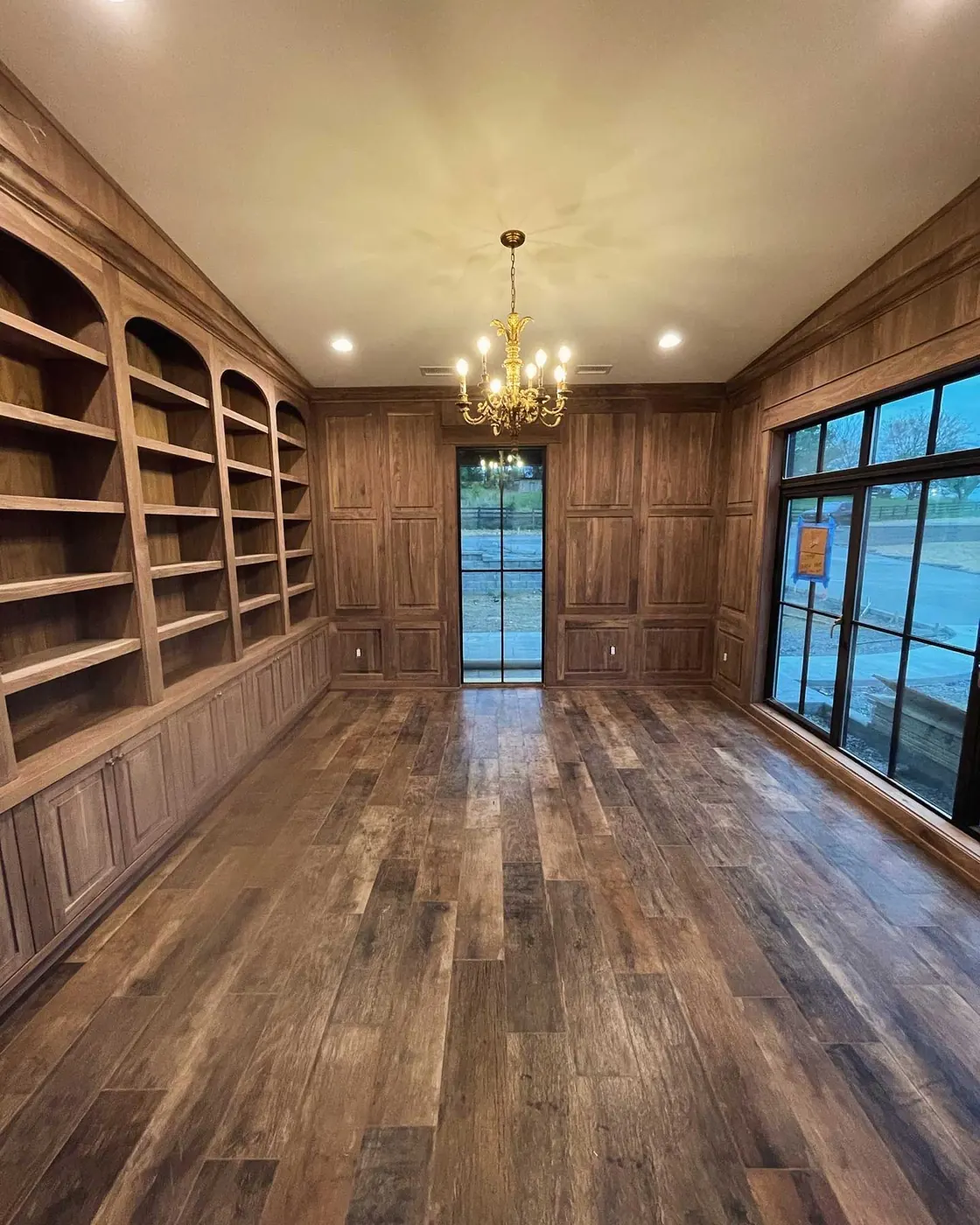
Walnut offers a striking, luxurious appearance, but it comes at a higher price point. It is often used selectively, such as on an island or a featured built-in, rather than throughout the entire kitchen.
Paint-grade cabinetry is its own category. If your plan is a painted finish, poplar or maple may be used strategically because they offer a smoother surface. Paying extra for a dramatic grain pattern only to cover it with paint is rarely the best use of your budget.
What to know about finishes
The finish affects both appearance and maintenance. Stain highlights the grain and variation of real wood, which is part of the appeal. It also means you should expect natural differences from one door to the next. That is not a flaw. It is one of the reasons solid wood feels authentic.
Paint creates a cleaner, more uniform appearance, but painted wood cabinets can show hairline movement at joints over time. Again, this is not necessarily poor craftsmanship. Wood moves naturally, and painted finishes tend to make that movement more visible than stain does.
A good finish schedule matters just as much as color choice. Proper prep, sealing, and topcoating help cabinets resist moisture, fingerprints, and everyday wear. If you have a busy kitchen with kids, guests, and constant use, ask less about the exact shade and more about how the finish is designed to hold up.
Custom, semi-custom, or stock
This is often where homeowners can save money without sacrificing the feel they want.
Fully custom solid wood cabinetry gives you the most flexibility. You can tailor storage, dimensions, trim details, specialty inserts, and architectural features around the way your family actually lives. For older homes in Nashville, Franklin, or Belle Meade, custom work is especially valuable because rooms are not always square and standard sizes do not always fit gracefully.
Semi-custom cabinetry can be an excellent middle ground. You get more flexibility than stock cabinets, often with solid wood options and quality finishes, but at a lower cost than full custom. For many families, this is the sweet spot between personalization and budget control.
Stock or RTA cabinetry may still have a place in the right remodel, especially if speed and cost are driving priorities. But if you are specifically shopping for solid wood cabinetry, compare more than the brochure description. Some stock lines offer solid wood fronts with more basic interiors or thinner materials elsewhere. That may be perfectly acceptable for a light-use space, but a heavily used family kitchen deserves a closer look.
Price expectations and what drives cost
Solid wood cabinetry costs more than laminate or particleboard-based options, but the range can vary widely. The final number depends on wood species, finish, construction quality, door style, storage accessories, installation complexity, and how customized the layout is.
Simple shaker doors in paint-grade wood will usually cost less than an inset design in walnut with custom organizers and decorative millwork. That does not mean one is better. It means the right investment depends on your priorities.
A smart approach is to decide where solid wood matters most. Some homeowners want a fully custom kitchen with premium interiors everywhere. Others get the best result by investing in visible statement areas – like the island, hood surround, or main perimeter cabinets – while simplifying less noticeable zones. Good planning keeps the kitchen feeling elevated without forcing every line item to be top tier.
Red flags to watch for in any solid wood cabinetry buying guide
If pricing feels unusually low, ask what is missing. It may be thinner boxes, limited finish prep, lower-grade hardware, outsourced installation, or unclear allowances that grow later.
You should also be cautious when a provider cannot explain lead times, moisture considerations, or installation standards in plain language. Cabinet quality is not just about materials in a catalog. Precise measuring, careful fitting, and clean installation are what make cabinetry feel built for your home rather than dropped into it.
This is one reason many homeowners prefer a local, consultation-driven process. When the same team is guiding design decisions, material selections, and project planning, there is less room for confusion and fewer surprises once the work begins.
How to decide if solid wood is worth it for your kitchen
For some households, the answer is an easy yes. If you plan to stay in your home, use your kitchen hard, and care about the details you see every day, solid wood cabinetry often delivers long-term value that cheaper materials do not.
For others, it depends. If the remodel budget is tight and you need to stretch every dollar, it may make more sense to combine solid wood elements with more cost-conscious choices elsewhere. The goal is not to chase a label. The goal is to build a kitchen that looks right, functions well, and holds up to real life.
At Tom Bell Cabinetry & Custom, that usually starts with a clear conversation about how you cook, how you live, and where your investment will matter most. The right cabinetry plan should feel beautiful, but it should also feel practical and grounded.
A well-made kitchen does more than improve resale value. It changes how your home feels on an ordinary Tuesday night, when the lights are on, dinner is going, and everyone gathers in the same room. That is the standard worth buying for.
Built in Nashville, Not Shipped in a Box
Tom Bell Cabinetry builds custom cabinets in Nashville, TN in our own Madison shop, using solid hardwood, plywood boxes, and a crew that measures, builds, and installs the same job. We also handle architectural millwork and custom built-ins across Middle Tennessee.
Call (615) 469-2781 for a free estimate.